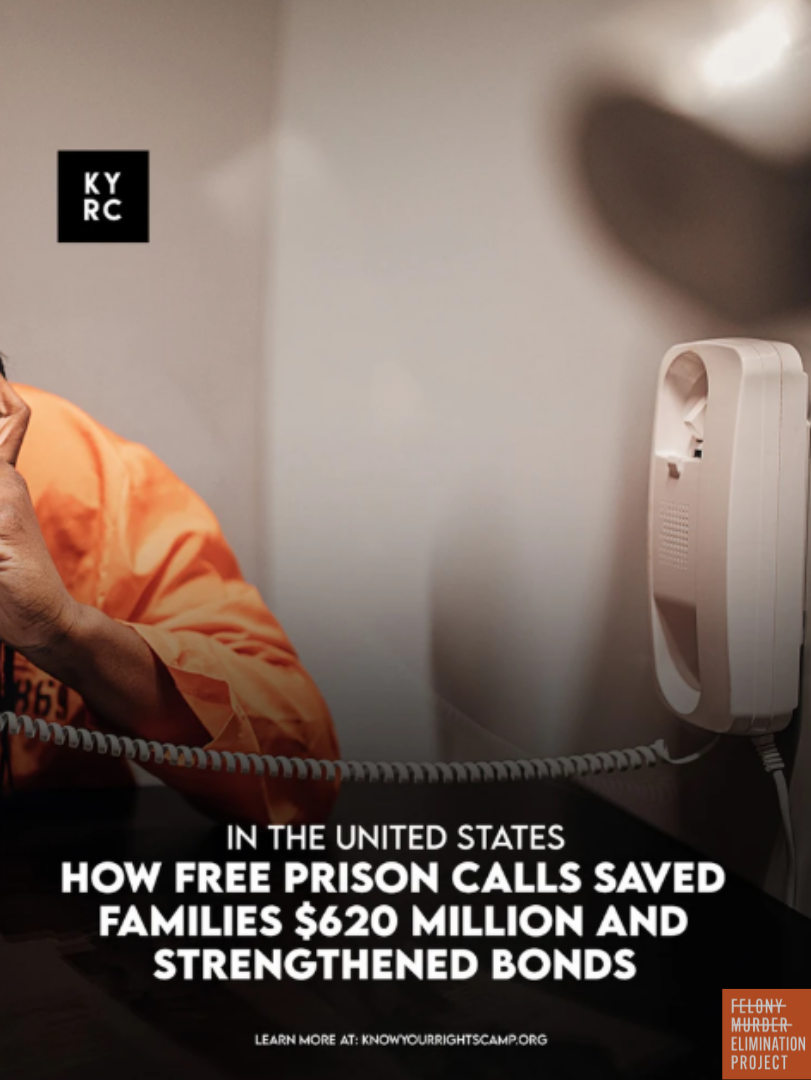
Thanks to policy changes in six prison systems and several dozen jail systems, free prison calls saved US families $620 million and strengthened bonds with their incarcerated family members, helping to lower recidivism rates.
California is one of a growing list of states and municipalities that have made phone calls free, starting with New York City in 2019. Today, calls are free in six prison systems (the Federal Bureau of Prisons, Connecticut, California, Minnesota, Massachusetts, and New York) and several dozen jail systems, affecting more than 330,000 incarcerated people. Nearly all of these reforms came through legislation (New York enacted the change administratively).
Since the policies went into effect, incarcerated people with access to free phones have placed an additional 600 million phone calls, according to a new report from the nonprofit Worth Rises, a leading advocate for free phone calls. Analyzing call data from all six prisons systems and 17 jails, both before and after calls became free, the authors calculated that free calling led to an additional 6.4 billion call minutes. And it wasn’t just a spike: Since increasing, the call minutes remained at the new, higher level.
Altogether, the free minutes have saved these families more than $620 million. The majority of the savings went to Black and brown families: 70 percent of prison savings and 82 percent of jail savings.
Free calling also means Angel Rice’s incarcerated husband spends more time talking with his mother and his 12-year-old daughter, who is autistic. “He can be on the phone with her to help her with her homework,” she said. “They have their nighttime regimen—they have a call before she goes to bed. And he’s able to chat it up with her, really have that bonding moment. Having these regular conversations allows him to be a part of her upbringing and make sure she has her father there. Every time he says, ‘I spoke to my daughter today,’ you can hear it in his voice. You can just hear him light up.”
Research shows what Rice and her family know firsthand: Family contact is crucial for people on both sides of the prison walls. Phone calls are shown to improve relationships, increase self-esteem, and reduce depression and anxiety among incarcerated people. And since visitation can be challenging for a host of reasons, phone calls are often people’s only lifeline to their loved ones.
Phones in prisons and jails are operated by third-party correctional communications companies. In order to win contracts, these companies have historically offered the jurisdiction a percentage of the profit. These kickbacks can actually disincentivize the prison or jail from negotiating a lower rate, since it would effectively decrease their share.
As a result, a 15-minute phone call from a US jail cost an average of $3.15 in 2021, and an in-state prison call averaged $1.20. These costs are paid by the people receiving the calls, who have to set up an account with the communications provider and add funds.
The two largest correctional communications companies—Aventiv (which rebranded from Securus) and ViaPath (formerly Global Tel Link)—control nearly 80 percent of the $1.5 billion correctional communications industry, which also includes video calling and electronic messaging.
When each state or municipality made calls free for users, it negotiated a new contract with the respective communications provider. In every case, now that the agency is footing the bill, the rate is significantly lower than what families were previously paying. On average, these rates dropped 62 percent for prisons and 68 percent for jails, demonstrating that families have been overcharged for decades.
“This is a win for everybody,” Bianca Tylek, executive director of Worth Rises, said.“It is better for the folks who are inside… It is obviously incredibly powerful for the families who are saving important resources, but also connecting to people who love them. It is changing the work environment for correctional officers who are in these spaces. And obviously in doing all of that, it’s returning multitudes to us as the general public, in reentry and public safety results.”