
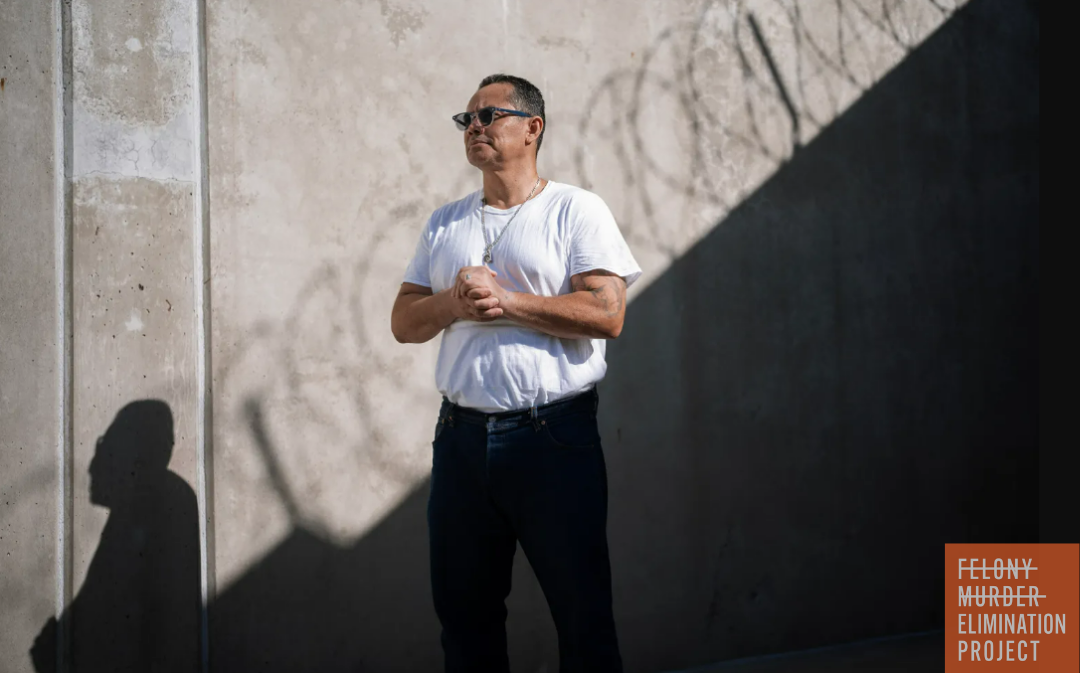
The following feature “He Spent 19 Years in Isolation on Death Row. Then the Handcuffs Came Off” appeared in CalMatters. It chronicles the journey of Johnny Morales, who was sentenced to death in 2005.
While on death row. Morales lived in isolation at San Quentin’s condemned housing until California Governor Gavin Newsom signed a 2019 moratorium on state executions. This led to Morales’ transfer to a lower-security prison environment, where he participates in rehabilitative programs and trains with the Peer Literacy Mentor Program to help provide education and reduce recidivism through restorative justice.
Excerpts from the feature appear below.
Johnny Morales struggled to find sleep. He dozed off for a few moments, but officers came to his death row cell and woke him a little after midnight. They needed to inventory and box up his belongings. He was leaving San Quentin.
Morales and hundreds of death row residents were gradually being transferred from San Quentin to facilities where they could be treated like any other prisoner. They’d have the opportunity to be part of a general population — to feel an unexpected sense of freedom while remaining incarcerated.
Still sentenced to death, they might never become eligible for parole or release. But, improving conditions for them points to bigger questions about incarceration: Do we want our prison environments to focus on rehabilitation and hope? Or should they cultivate harsh punitive conditions? What’s best, in the long run, for public safety outcomes?
The change followed one of Gov. Gavin Newsom’s signature criminal justice policies. In 2019 — just three years after Californians passed an initiative meant to speed up executions — Newsom handed down an executive order suspending the death penalty. It led to the dismantling of the death chamber at San Quentin and the dissolution of the condemned housing unit there.
Because of his near-perfect record of conduct, Morales merited being rehoused at the lowest security level permissible for someone without any current chance at parole. California State Prison-Sacramento just converted a section of its housing to this lower security level and would become his next destination, his new home.
Non-designated facilities generally focus on providing more educational and rehabilitative opportunities. Violent problematic prisoners ultimately push themselves to the higher security levels and harsher environments, while positively programming individuals strive to get along.
The freedom to mingle like a normal prisoner means Morales can now encourage and help others find a positive path. From the start in New Folsom, he used his bilingual skills to tutor the Spanish-speaking community on his own whenever he could, remembering how difficult it was for him to navigate jail and prison without knowing English.
The education department noticed and quickly assigned Morales a job as a clerk and teaching aide. When the Peer Literacy Mentorship Program came to his yard, he applied and was chosen to participate. The program formally trains and certifies guys like him to teach GED coursework to his incarcerated peers.
Morales stays busy, busy, busy. He just started his first community college class, English 101. College enrollment includes an assigned laptop to do his coursework and submit his work via WiFi. His world right now continues to evolve.
“I’m still a rookie in all this, still a baby,” said Morales. “I really wanna rehabilitate myself. I wanna do it the right way. I always felt before like I was a good person because I stayed away from drugs, from alcohol — things that violate the rules in prison. I was never involved in fights or contraband.
“But it wasn’t until I got here that I learned that considering myself a good person does not necessarily mean I’ve been rehabilitated, not in a proper way.”
You can read the full feature, “He Spent 19 Years in Isolation on Death Row. Then the Handcuffs Came Off” at the CalMatters website. CalMatters is a nonpartisan and nonprofit news organization bringing Californians stories that probe, explain and explore solutions to quality of life issues while holding our leaders accountable.