
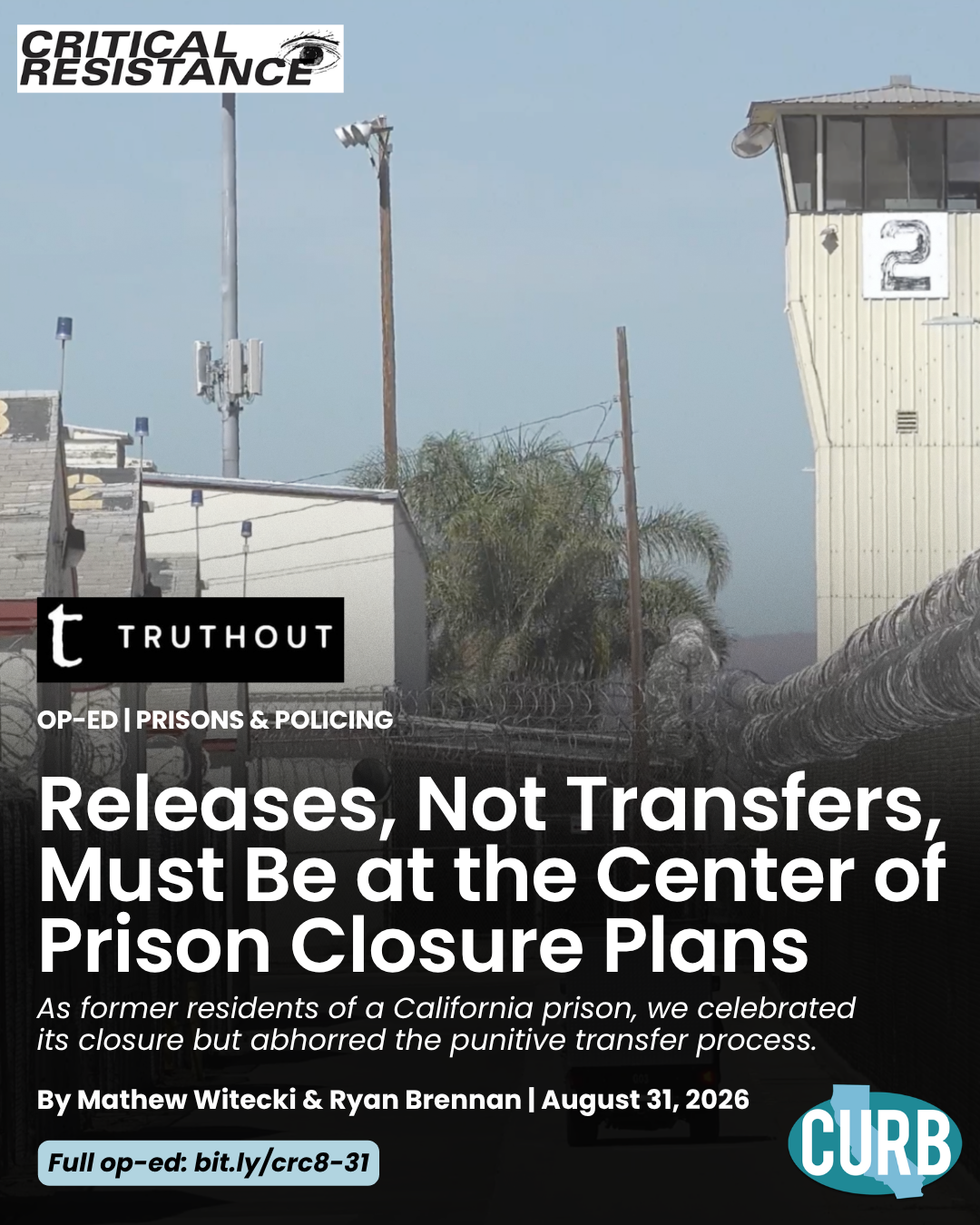
The following opinion/editorial “Releases, Not Transfers, Must Be at the Center of Prison Closure Plans” appeared August 31st on the Truthout website, and is written by Mathew Witecki and Ryan Brennan.
Excerpts appear below.
For decades, the California Rehabilitation Center (CRC) in Norco has been known for its deplorable conditions: extreme heat, pest infestations, unreliable programming, and water so unsafe that guards refuse to drink it. As residents of CRC, we experienced these conditions firsthand. So we celebrated when the California Department of Corrections and Rehabilitation (CDCR) announced in August 2025 that CRC had been named for closure. Almost one year later, as of July 29, 2026, CRC has officially been emptied. Today, the empty prison remains in “warm shutdown” mode, costing the state hundreds of millions of dollars.
There is much to learn from looking back at CRC’s closure process. During its closure, imprisoned people in CRC Norco have been subjected to a gauntlet of unnecessary burdens and persecution, similar to those endured in prior closures. California needs to close more prisons — they cause more harm than they address while draining billions of dollars in resources from the communities that need them most. But we also can’t let the CDCR use closures as an excuse to punish imprisoned people with tumultuous transfers, denial of food and medicine, restricted access to rehabilitative programming, and retaliation. Releases, not chaotic transfers, must be the center of any future closure plan.
For those who remained inside CRC during the closure process, including college students finishing classes at Norco College or UC Riverside’s prison education program, conditions rapidly worsened. After the announcement of CRC’s closure, we were moved to the “punishment dorm,” where roughly 200 people were packed together with only six small tables for studying. We endured barely functioning sinks and showers, cockroach infestations, and unbearable heat with no working swamp coolers or ventilation. These conditions served no legitimate purpose and disrupted those trying to study, participate in programs, and cope with institutional stress.
For others, the transfer process carried its own set of abuses.
Calls for transfer came with no warning, and often in the middle of the night. This is standard protocol, as exhaustion is meant to disorient us. Caffeine and nerves had us trembling as we marched to the transfer cages. We waited in that cramped concrete box until 7:45 a.m. with nothing to eat but a single PB&J. After hours on a prison bus, shackled at the waist, ankles, and wrists, the same snack was provided again while we waited at the receiving institution. These are the conditions of transfer: hunger, exhaustion, and nagging uncertainty — all used to mentally subdue us.
During transfers, some wait weeks for belongings, and others never receive them. A person’s property can disappear without a trace, with no consequences for staff involved. To make matters worse, CSP-LA was in no hurry to issue state clothing. With only one outfit and no winter apparel, those of us without clothes went freezing in our cells with no food, hygiene products, and nothing to do but think and wait.
These harms are not an inevitable part of the prison closure process. Instead of addressing preventable problems, CDCR has used transfers, overcrowding, and long program waitlists to argue for preserving and expanding corrections budgets, even as incarcerated populations decline. The most insidious part: CDCR uses the allure of initiatives that, in reality, mask the harms of incarceration by building “kinder, gentler cages” to justify its power grabs, convincing lawmakers that spending billions on newer prisons and other gimmicks are somehow the antidote to the devastation that prisons cause in the first place. Reducing reliance on a toxic prison system and preventing harm are not at odds; in fact, they must go hand in hand.
The state can take concrete steps to mitigate harm, the clearest being prioritization of releases over transfers in closure plans. One way to do this is by evaluating people for resentencing eligibility when a prison gets named for closure. On average, it costs at least $128,000 annually to imprison one person, with additional resources being spent on the transfer process. If individuals are assessed for release following a closure announcement, the transfer process could be avoided altogether and eligible individuals can return home.
The suffering unfolding at CRC and in the transfer process is not a necessary part of closure. These are choices made by CDCR and CRC staff. As CDCR continues to push prison expansion, California can and should remain focused on closing more prisons without the abuse. Future plans should center releases over transfers so closure meaningfully reduces the human cost of incarceration.
You can read the full op/ed “Releases, Not Transfers, Must Be at the Center of Prison Closure Plans” at the Truthout website. Truthout is a nonprofit news organization dedicated to providing independent reporting and commentary on a diverse range of social justice issues.
Mathew Witecki is a 2026 graduate of University of California, Riverside with a bachelor’s degree in Education, Society, and Human Development and an inside advocate with Californians United for a Responsible Budget (CURB). Mathew was imprisoned at the California Rehabilitation Center (CRC), Norco and transferred to San Quentin. He is scheduled to be released in 2027 and hopes to continue his education in the Masters of Public Policy program at UCLA.
Ryan Brennan is a queer advocate and community organizer. While in prison, he developed and facilitated the LGBTQ Allies program. He also earned a bachelor’s degree in organizational studies from Pitzer College. It was this program that inspired him to become a Prison Industrial Complex (PIC) abolitionist. Ryan is currently imprisoned at CSP-LAC, Lancaster. He plans to continue organizing against the PIC when he is released at the end of the year.