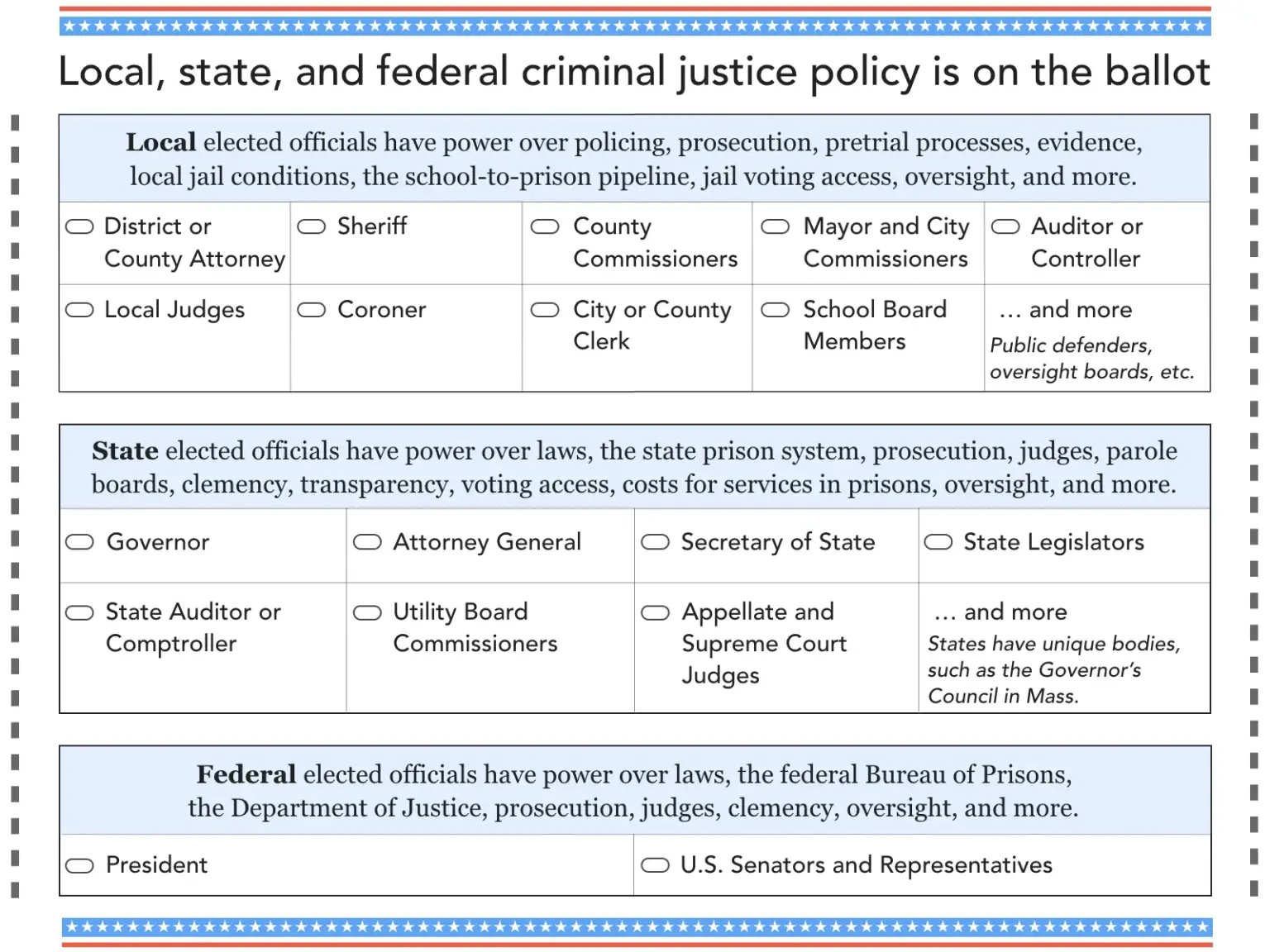
The US Midterm Elections are two weeks away, and mass incarceration is on the ballot. While presidential campaigns get most of the attention from the news media, many lesser-known down-ballot races can have a much more dramatic impact on criminal legal system reform in America.
For voters dedicated to ending mass incarceration, here are some of the local offices you can cast your ballot for, and the role those offices play in making decisions to reduce the number of people behind bars, improve conditions in prisons and jails, and help turn the page on America’s failed experiment with mass incarceration.
District/County Attorneys
Because of their immense power, government prosecutors known as district attorneys (sometimes called county attorneys) loom large in any discussion about the criminal legal system and what can be done to reform it. And it is important to remember that the person who holds this office has immense discretion in how to use this power.
They oversee the vast majority of criminal cases in their jurisdiction. Not only do they determine which types of offenses to prioritize for prosecution, but in individual cases, they also determine whether to bring charges against someone and, if so, for what crime.
They also serve as gatekeepers to diversion programs. These programs allow people charged with crimes to resolve their cases without a criminal conviction and, in many cases, without incurring charges. The district/county attorney decides what those diversion programs look like, whom they are offered to, and what happens when someone completes it.
Sheriffs
Sheriffs play many roles in the criminal legal system that can vary greatly from state to state and county to county. Generally speaking, though, their core responsibility is running the county jails, making them responsible for managing the conditions in which people are detained pretrial. Importantly, in this role, they’re responsible for the health and safety of people who are in their custody, including what health services they have access to while incarcerated. Additionally, they enter into contracts with private companies that provide services, such as phone calls, commissary sales, and tablet computers. They decide what people detained in their jails are charged for these services.
Additionally, many sheriffs also conduct law enforcement activities and criminal investigations. This gives them wide latitude in determining who is arrested and for what offenses.
County Commissioners
County commissioners generally have two primary responsibilities when it comes to the criminal legal system, and have powerful leverage to ensure law enforcement is doing everything it can to reduce the number of people stuck in jail unnecessarily.
First, they provide oversight of the county jail, including setting budgets and approving contracts for services. Notably, they are also often responsible for considering proposals for new jail construction. During debates about building a new jail or expanding an existing one, county commissioners have powerful leverage that they can and should use to ensure that prosecutors and law enforcement are doing everything they can to reduce the number of people stuck in jails unnecessarily.
Second, they allocate funding and, in some jurisdictions, provide oversight of the county sheriff’s department. This can influence the law enforcement presence in the community and the activities the department is tasked with prioritizing.
City/County Auditors and Controllers
Auditors can act on behalf of residents to provide much-needed transparency.
City and County Auditors do far more than just monitor the spending of agencies (although they can, in fact, do that). They also look at the overall performance of key departments. For example, they can look at how jails are administering their welfare funds, how police departments are responding to the needs of the communities, jail conditions, the administration of the county’s bail practices, how public housing and health care providers are delivering services, and much more. Through their work, auditors and controllers can act on behalf of residents of their community to provide much-needed transparency and ensure their government is properly and effectively serving them.