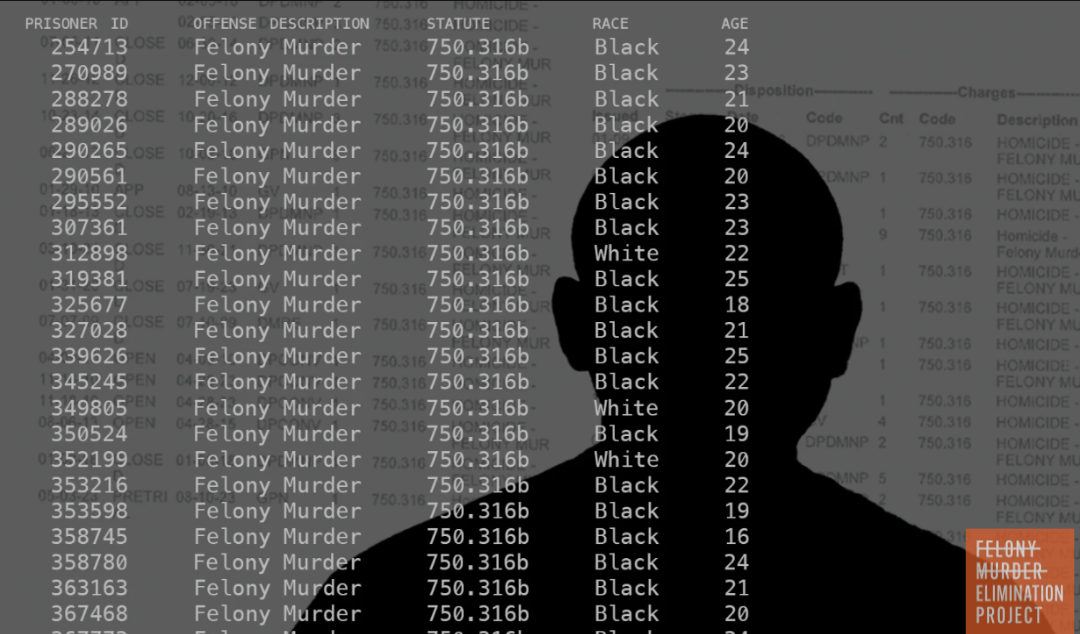
In collaboration with the Yale Investigative Reporting Lab, Michigan Public published the story “Serving life for an unintended death: how felony murder locks up Black Michiganders.” The report found people convicted of felony murder in Michigan are disproportionately young and Black. Black people were convicted of felony murder at a rate about three times higher than white people imprisoned for the same types of crimes.
In Michigan, a felony murder conviction carries a mandatory sentence of life without parole. Prosecutors decide when to bring the charge. In the words of one judge, “they can pretty much do whatever they want.” Felony murder makes up 1 in 3 first-degree murder convictions in Michigan (685 felony murder convictions out of 2,087 people convicted of first-degree murder since 2000), yet prosecutors don’t have to prove someone intended to kill to win a conviction for felony murder.
Just over 70% of people convicted of the charge in Michigan since 2000 are Black, and were about three times more likely to be convicted of felony murder, compared to white defendants imprisoned for the same types of crimes. Additionally, nearly 60% of people convicted of felony murder in Michigan were 25 or younger at the time of the offense, Michigan Public found. Among young people, the charge also accounts for a much higher proportion of first-degree murder convictions: the younger the defendant, the more likely it is their life sentence came from felony murder.
“I deeply worry that felony murder … means that those who don’t have the resources to demand equal treatment will simply have to swallow extraordinary punishments,” said Ekow Yankah, professor of law and philosophy at the University of Michigan. “And it’s done quite out of view,” Yankah added, “until we look up one day and see the horrific stats.”
You can read the full story “Serving life for an unintended death: how felony murder locks up Black Michiganders” at the Michigan Public website.
The story’s author, Etai Smotrich-Barr, is a Reporting Fellow at Michigan Public, in collaboration with the Investigative Reporting Lab at Yale.
The Yale Investigative Reporting Lab aims to enhance the power of collaborative public-interest journalism, and seeks to deepen coverage of criminal justice, climate change, migration, mental health, and other themes, through experimentation with team-driven methods, pursuit of public records, new forms of multimedia storytelling, and more.