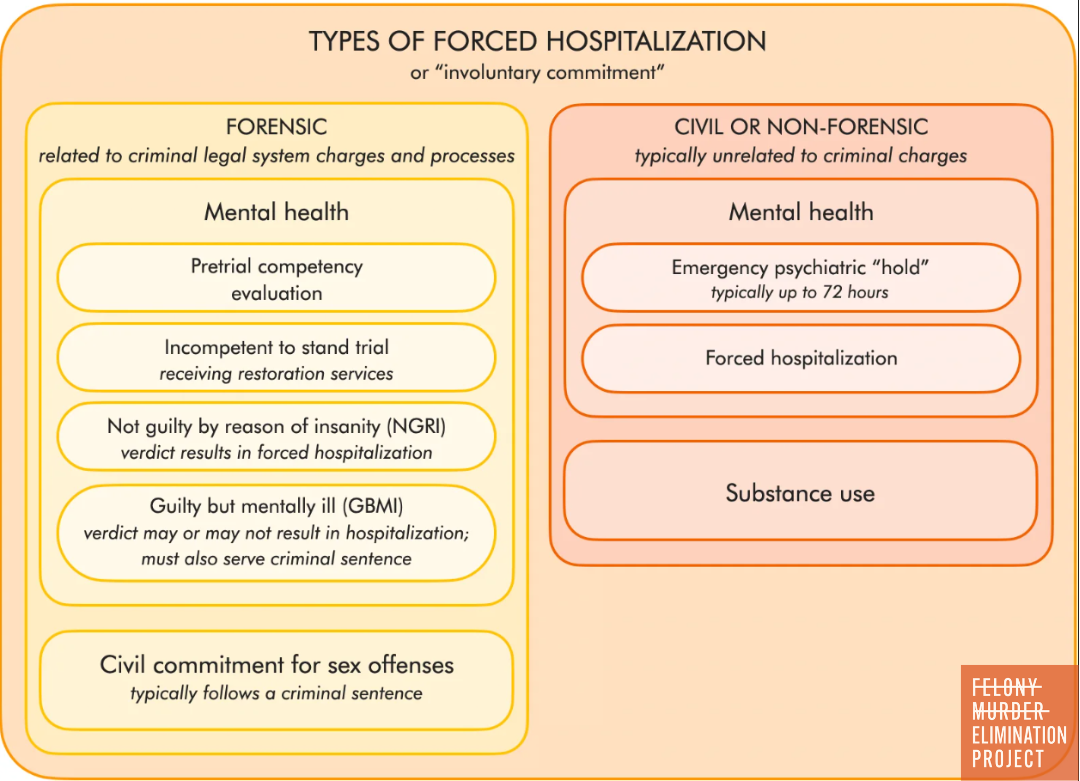
In “Involuntary Commitment: How Forced Hospitalization Expands the Criminal Legal System” a recent report from Prison Policy Initiative, shows forced psychiatric hospitalization expands the carceral system by criminalizing marginalization, enmeshing medical care with law enforcement, and institutionalizing social control under the guise of treatment.
Of the two million people currently incarcerated in the United States, the latest methodologically sound estimates of the number of persons in jails and prisons diagnosed with major depression, schizophrenia, and other psychotic disorders, and bipolar disorder yielded percentages ranging from 16 to 24 percent; between 320,000 and 480,000 people.
While far‐reaching structural changes have been made in the mental health care system in the United States, many severely and persistently mentally ill persons who come into contact with law enforcement now receive their inpatient treatment in jails and prisons, in large part because of a dramatic reduction of psychiatric inpatient beds. While more high‐quality community treatment is needed, such as intensive case management and assertive community treatment, 24‐hour structured care is needed in the mental health system completely separate from the criminal legal system to decrease criminalization.
Another drawback of this expansion is that when a mentally ill individual is arrested, that person now has a computerized criminal record, which is easily accessed by the police and the courts in subsequent encounters. This can impact jurisdictional decisions and reinforce the tendency to choose the criminal justice system over the mental health system. It also provides a significant detriment to a mentally ill person, who now has to deal with the detrimental impact a criminal record has on their ability to secure employment and housing down the road.
This growing expansion of the criminal legal system intervening in mental health treatment occurs in three mechanisms:
Police Involvement: Law enforcement officers frequently initiate civil commitments, handcuffing and transporting distressed individuals to emergency rooms, which merges police power with medical evaluation.
Jail Overcrowding: People awaiting court-ordered forensic evaluations or psychiatric beds routinely languish in local jails, converting correctional facilities into holding pens for untreated disabilities.
Transinstitutionalization: Closing voluntary community care options in favor of coercive mandates shifts vulnerable populations from streets and prisons into locked institutional spaces without improving actual wellness.
The cumulative impacts on the criminal legal system:
Police Involvement: Law enforcement officers frequently initiate civil commitments, handcuffing and transporting distressed individuals to emergency rooms, which merges police power with medical evaluation.
Jail Overcrowding: People awaiting court-ordered forensic evaluations or psychiatric beds routinely languish in local jails, converting correctional facilities into holding pens for untreated disabilities.
Transinstitutionalization: Closing voluntary community care options in favor of coercive mandates shifts vulnerable populations from streets and prisons into locked institutional spaces without improving actual wellness.
Read the full report “Involuntary Commitment: How Forced Hospitalization Expands the Criminal Legal System” on the Prison Policy Initiative website. Prison Policy Initiative is a non-profit, non-partisan organization that produces cutting edge research to expose the broader harm of mass criminalization, and then sparks advocacy campaigns to create a more just society.