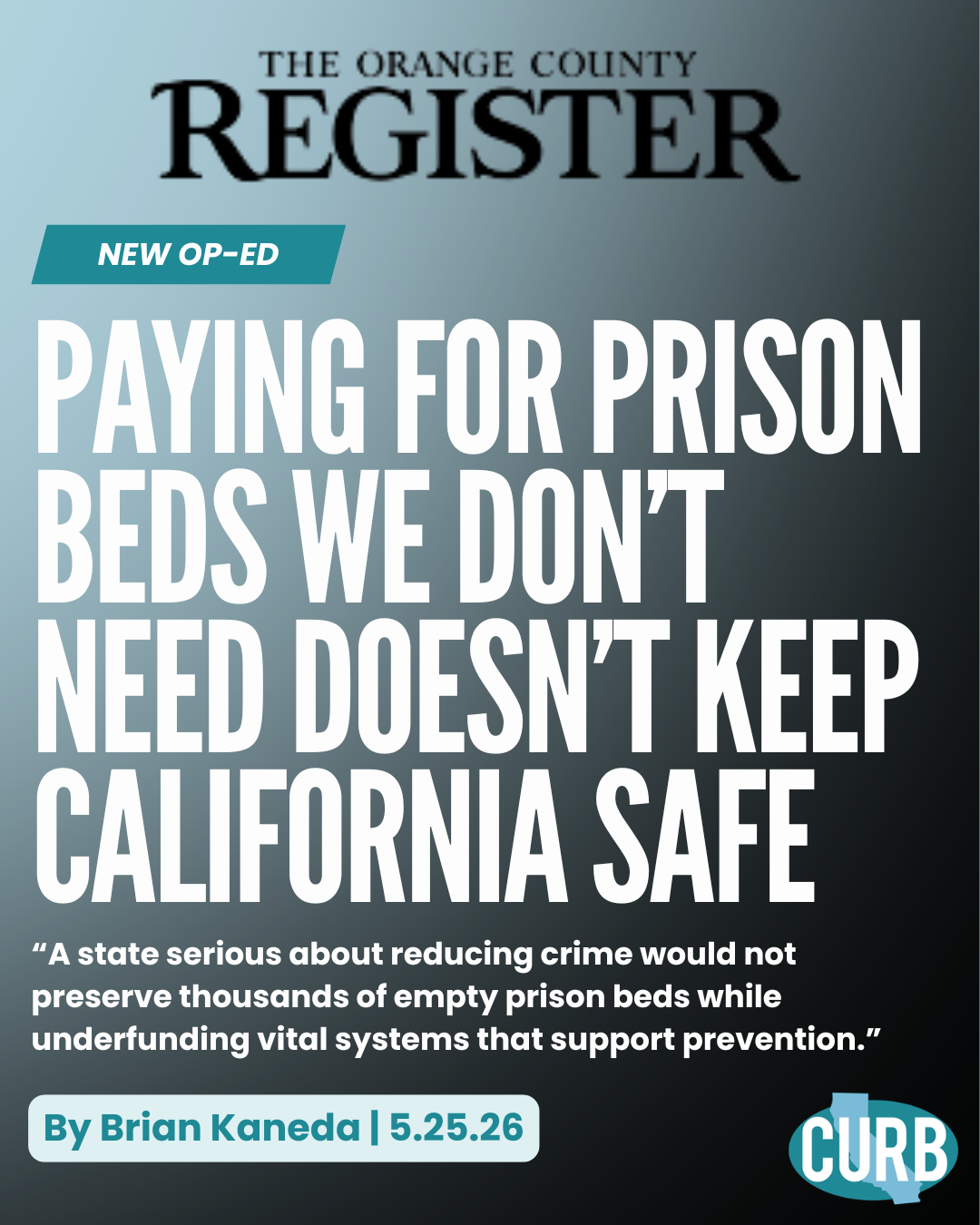
The opinion-editorial piece “Paying for Prison Beds We Don’t Need Doesn’t Keep California Safe” appeared on May 25th in the Orange County Register, and is written by Brian Kaneda, Deputy Director of Californians United for a Responsible Budget (CURB).
Excerpts from the piece appear below.
California needs to close more state prisons. Reviewing Newsom’s May Revision makes that impossible to ignore.
The May Revision, Newsom’s annual revised budget proposal, gives the Department of Corrections and Rehabilitation (CDCR) about $1 billion more than last year’s enacted budget, even as California’s prison population continues its long-term decline. From January to the May Revision, total proposed State Funds spending increased by $477.5 million on net. The broader Corrections and Rehabilitation agency total accounted for $460.8 million of that net increase — about 96.5% — after increases and decreases across all state agencies were added together. And yet, California’s prison population has fallen by roughly 70,000 people since 2010.
CDCR’s savings record should alarm lawmakers. The 2024 Budget Act set a $392 million annual savings target for the department. CDCR delivered less than half. The state then authorized up to $20 million for Boston Consulting Group to identify
operational savings across CDCR and other departments. CDCR’s share was initially estimated at $644 million by 2028-29. In March, state budget analysts suggested that the Legislature should view unallocated savings proposals skeptically, citing repeated examples where assumed savings from these exercises had proven difficult or unachievable, and in some cases had obscured the true size of the deficit. By the May Revision, its identified BCG-related ongoing savings had fallen to $116 million, an 82% collapse.Prison closure has proven to be the most effective tool for reducing CDCR spending at scale. That is why the Legislature must demand it. The state’s four completed and planned closures are projected to save $594 million General Fund annually by
2027-28; the May Revision credits closures and deactivations with $4.9 billion in cumulative savings through the same period.Recent crime trends do not justify preserving excess prison capacity. The Public Policy Institute of California, a nonpartisan research organization, reports that violent crime fell 5.3% in 2024 and property crime fell 9.9%, reaching its lowest level since
1985. None of this means California has met its public safety goals. However, the state must stop treating unused prison space as a crime-prevention strategy. Paying for prison capacity the state no longer needs does not prevent harm. Funding the things that actually stabilize communities will. Those programs lose out when closure savings are absorbed back into CDCR.A state serious about reducing crime would not preserve thousands of empty prison beds while underfunding vital systems that support prevention. It would close excess capacity and redirect the savings into job programs, youth support, voluntary treatment, housing, reentry, and survivor services.
You can read the full opinion editorial piece here –>> Paying for Prison Beds We Don’t Need Doesn’t Keep California Safe
Brian Kaneda is the Deputy Director of Californians United for a Responsible Budget (CURB). CURB is a Black-led statewide coalition of more than 80 grassroots organizations. CURB’s three point mission is to reduce the number of incarcerated people in California; reduce the number of prison and jails in our state; and shift wasteful spending away from incarceration and toward healthy community investments.