A recent report from Prison Policy Initiative, “Punishment Beyond Prisons 2026: Incarceration and supervision by state” captures the full picture of mass incarceration in the United States, apart from what is known of the incarcerated population.
Nearly 3.7 to 4.4 million people in the US are on probation or parole. Known as community supervision, this system serves as a major driver of incarceration, with technical violations (breaking rules rather than committing new crimes) accounting for roughly one-quarter of all prison admissions, with over 40% of state prison admissions nationwide stemming from violations of supervision. While technically “out” of prison, individuals on probation or parole are under active surveillance and strict, often punitive, conditions.
Mass incarceration also encompasses the significant population held in jail pretrial due to an inability to pay money bail and individuals re-incarcerated for violations while on parole. Over 400,000, a number representing over 60% of people held in local jails, have not been convicted of a crime and are awaiting trial. Median bail for a felony is over $10,000, while the average yearly income of a person who cannot afford bail is roughly $16,000, leading to long-term detention for the poor.
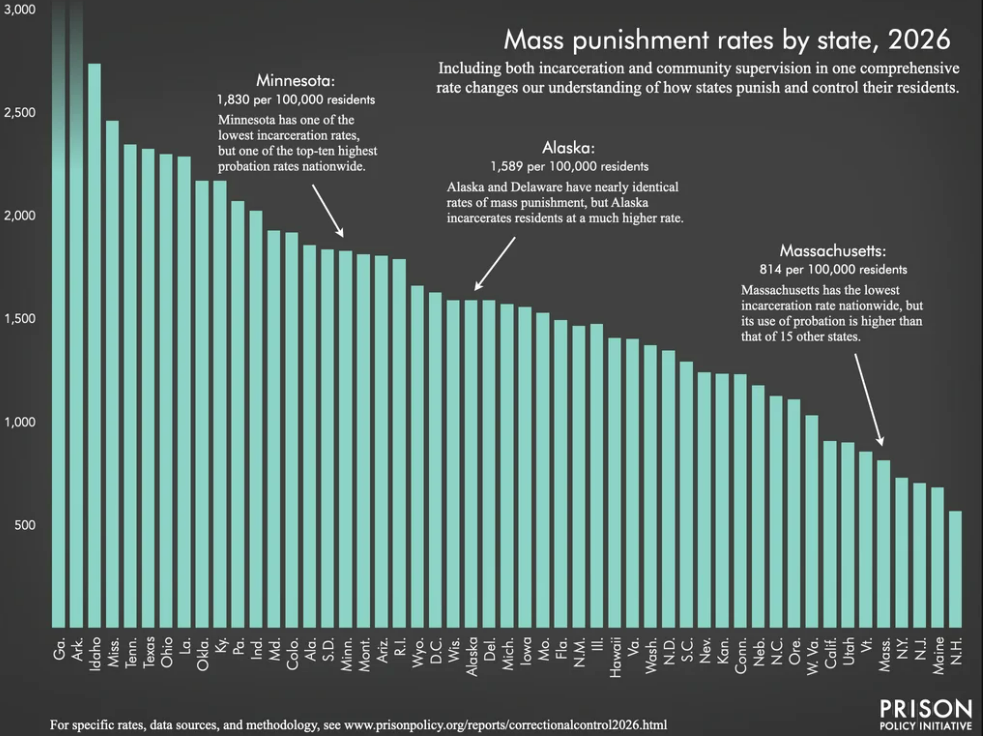
From the report, looking at mass punishment rates by state:
- In nearly every state, more than half of people under correctional control are on community supervision; in 20 states, more than two-thirds are on probation or parole rather than behind bars.
- Residents of Colorado are more than twice as likely to be within the mass punishment system (1,919 per 100,000 residents) as those in neighboring Utah (901 per 100,000).
- Georgia has long led the nation in its use of probation (a staggering rate of 3,272 per 100,000 residents), but also has a top-ten incarceration rate (848 people in prisons and jails per 100,000), making it the most punitive state by a long shot.
- Louisiana uses all forms of punishment at consistently high rates, with similarly high rates of prison and jail incarceration, parole, and probation.
The report also notes some states’ attempts to reduce the net of mass incarceration:
A handful of syates have been chipping away at the harms and overuse of probation. For example:
- In 2025, Virginia passed bipartisan measures that make it easier to reduce probation terms by helping people secure housing, employment, healthcare, and other key components of stability, rather than imposing irrelevant and burdensome conditions on them.
- In 2023, Pennsylvania’s Act 44 became law, overhauling one of the most punitive probation systems in the country. The new law limits incarceration for non-criminal violations, uses an individualized approach to setting conditions, and allows for termination of supervision for those who no longer need it.
- In 2022, a diverse coalition of Florida lawmakers transformed probation through Senate Bill 752, which created remote reporting options and implemented credit systems to reduce probation terms through education or employment.
You can read the full report, “Punishment Beyond Prisons 2026: Incarceration and supervision by state” at the Prison Policy Initiative website. Prison Policy Initiative is a non-profit, non-partisan organization that produces cutting edge research to expose the broader harm of mass criminalization, and then sparks advocacy campaigns to create a more just society.