As part of it’s Life Inside series, the Marshall Project published the essay “What, to the American Incarcerated Person, Is Your Fourth of July?”
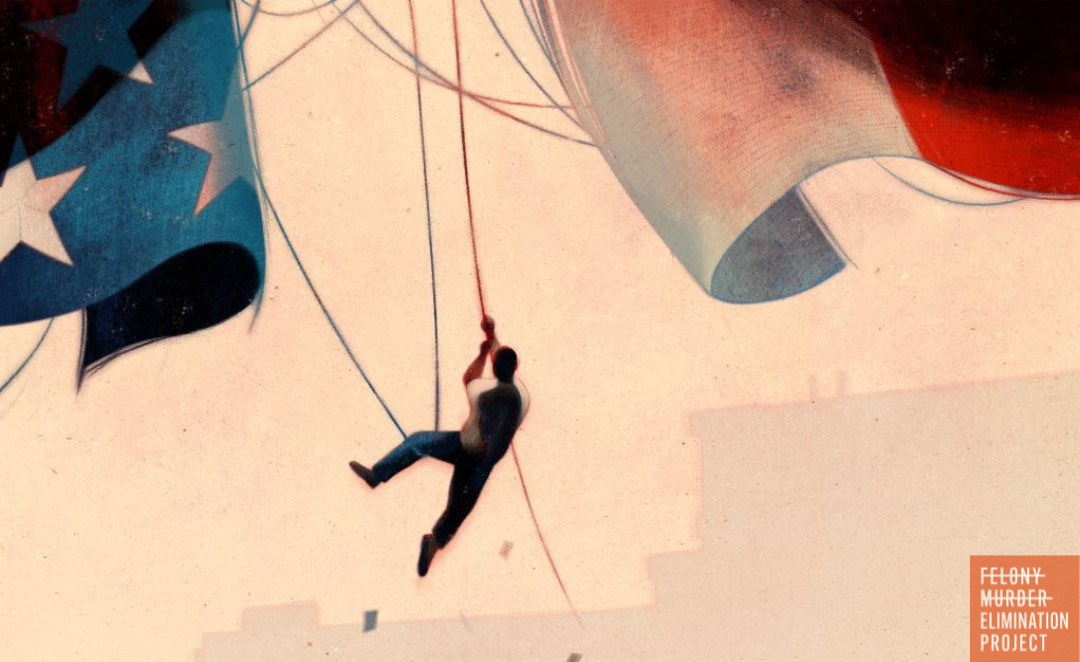
Celebrating America’s Independence Day in prison highlights the contrast between the nation’s stated ideals of “liberty and justice for all” and the reality of mass incarceration. It forces incarcerated people to reconcile forced state-dependency and lost human rights with a holiday ostensibly built on freedom. The core of Independence Day is self-determination. In prison, every basic choice; when to wake up, what to eat, and who to see, is strictly controlled by the state.
The legacy of abolitionist Frederick Douglass is often invoked speaking to this contrast. In his historic 1852 speech, “What, to the Slave, Is the Fourth of July?“, he critiqued celebrating a free nation while millions were still in chains. Today, incarcerated writers use this exact framework to question how a country can celebrate freedom while operating the world’s largest prison system.
Additionally, in many facilities, incarcerated labor remains a harsh reality. Because of a specific exception in the 13th Amendment, forced labor is still legally permitted as a punishment for a crime, drawing direct parallels to historical enslavement.
Excerpts from “What, to the American Incarcerated Person, Is Your Fourth of July?” appear below.
Franklin McPherson, 38
Shawangunk Correctional Facility, Wallkill, New York
As a modern-day American slave — because that’s what I am, thanks to a loophole in the 13th Amendment that still allows enslavement as a punishment for crime — July 4th is full of heartache, embarrassment and disappointment. It’s also a cruel reminder of how the criminal legal system is violating my 8th Amendment rights against cruel and unusual punishment.
So every Fourth of July — with a range of emotions — I cry in my cell. I’m sad and confused about how a nation can celebrate Independence Day when it forces millions of prisoners to be reliant on the state for their basic needs.
And I’m angry and frustrated because people should be marching and rallying for Congress to [amend] the 13th Amendment and for New York state to stop using slave code-style laws on its prisoners.
Frederick Douglass said it best when he called July 4th “a day that reveals to [the slave], more than all other days in the year, the gross injustice and cruelty to which he is the constant victim.”
Jeremy Zielinski, 41
Woodbourne Correctional Facility, Woodbourne, New York
America has one of the highest incarceration rates on Earth. Still, nothing brings liberty to mind like hearing fireworks from behind a 30-foot wall. Are America’s prisons corrupt, oppressive and exploitative? Of course. But I celebrate because I can. I know that independence isn’t a historical event, but principled defiance. It’s the power of a mind that recognizes its own freedom from external control. If tyranny is a boot on the neck of a nation, liberation is using your last breath to laugh at the person wearing it.
Lucretia Stone, 52
Edna Mahan Correctional Facility for Women, Clinton, New Jersey
I am writing from the only female correctional facility in New Jersey, which is ironically located on Freedom Road. Each year, the Fourth of July further solidifies something for me: Freedoms, liberties and justice are only applicable to some of America. With mass incarceration, the prison industry has become a billion-dollar business. As a result, the incarcerated people are being warehoused and treated like capital, instead of human beings capable of rehabilitation and change. That’s why independence is still a dream deferred. But while my body is enslaved as per the Constitution, my mind will always be free.
LeShunta Sanders, 50
Harlem, New York
As a formerly incarcerated woman of color, the Fourth of July feels hollow, like a celebration that overlooks the millions of people locked away and the many more of us still carrying the weight of that experience long after release.
When I was incarcerated, July 4th came and went like any other day. The fireworks we couldn’t see, the music we couldn’t dance to, the family barbecues we couldn’t join, they all served as reminders of how far we were from the freedoms being celebrated. The country’s declaration of liberty rang loud, but it never included us.
Even now, so-called “freedom” is complicated. The system didn’t just punish me; it tried to brand me. I’ve had to fight to be seen as more than my past — to be treated with dignity, to be given opportunity, to be heard. Independence feels like a right for some, but a privilege others must earn over and over again.
Still, I reclaim this day in my own way. I think of the women still confined, the ones who taught me resilience and sisterhood in the darkest places. I think of all of us building new lives despite the barriers. July 4th isn’t my Independence Day — but it is a reminder that the struggle for real freedom is still alive. That we still have stories to tell. That we’re still here.
And we will not be silent.
You can read the full essay, “What, to the American Incarcerated Person, Is Your Fourth of July?” at the Marshall Project website. The Marshall Project is a nonpartisan, nonprofit news organization that seeks to create and sustain a sense of national urgency about the U.S. criminal justice system.