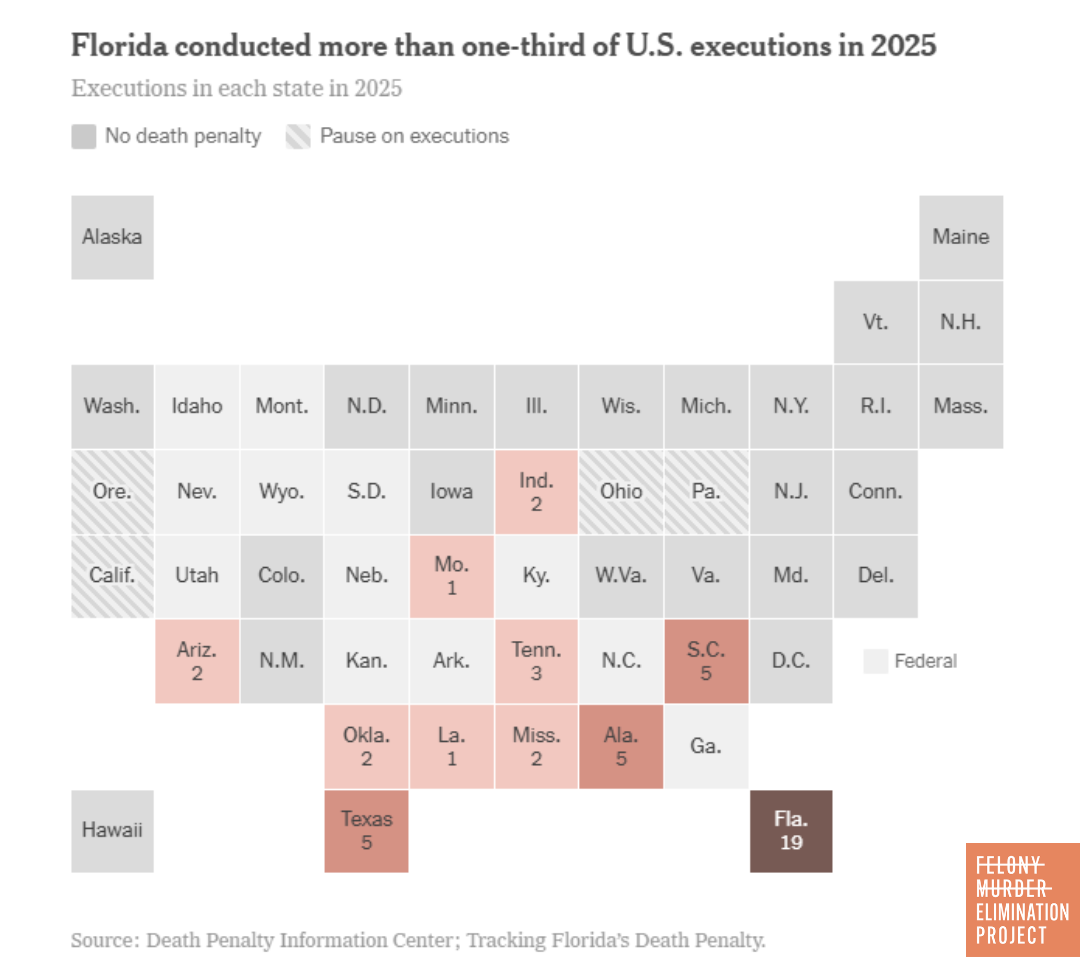
The opinion piece “The Death Penalty is Even More Horrifying Than You Think” was featured in the New York Times opinion pages March 13th, 2026. While national support for the death penalty has fallen to its lowest level in over five decades (around 53-56%), the number of executions in 2025 nearly doubled compared to previous years, creating a divergence between public opinion and state actions.
The 2025 increase was largely driven by a small number of states, particularly Florida, Alabama, Oklahoma, and South Carolina, whose governors and officials often seek to clear out the backlog of people incarcerated on death row . These actions are frequently politically motivated, aimed at projecting a tough on crime stance, especially in conservative jurisdictions.
That the death penalty receives a spotlight from the United States’ largest newspaper serves to remind us that the work toward progressive and informed, humane, and data-driven decision making in criminal justice policy remains in progress.
Excerpts from the opinion piece are featured below.
The use of the death penalty has risen sharply in the United States, with more executions in 2025 than any year since 2009. It is a cruel and unjust development.
In theory, the death penalty is reserved for “the worst of the worst.” In practice, it is very different. People who are executed for their crimes are disproportionately poor or intellectually disabled and often lacked good lawyers. They are also more likely to be sentenced to death if they have been convicted of killing a white person.
The death penalty is a fraught subject because most people on death row are guilty of murder and deserve tough punishment. But a life sentence without parole is a tough punishment. And the death penalty is both unavoidably flawed and unworthy of a decent society. As long it exists, it will disproportionately spare criminals with more resources and be used against people who are poor, mentally disabled or otherwise vulnerable.
Much of the world has come to this same conclusion. The list of countries that have abolished or effectively ended the death penalty includes all of Western Europe, Canada, Mexico, Argentina, Brazil, Chile, Morocco, South Africa and Australia. By continuing to execute people regularly, the United States puts itself in the company of only about 20 countries, among them Afghanistan, China, Iran and North Korea.
Over the past year, the United States has become even more of an outlier among democracies because the states that still conduct executions have accelerated the pace. Many of these states have in recent years passed secrecy laws to hide the details of what they are doing. We urge Americans not to look away.
This editorial board has long argued for the abolition of the death penalty. It is a form of institutionalized vengeance that causes a society to mimic the behavior of its worst offenders. It does not deter crime any more than life imprisonment does, studies show. These are the reasons that so much of the world no longer executes people.
In the absence of abolition, this country should at least take steps to reduce the worst injustices of the death penalty. The chances that an innocent person will be executed remain far too high. People on death row should have every opportunity to present evidence that calls into question their conviction.
You can read the full opinion piece “The Death Penalty Is Even More Horrifying Than You Think” at the New York Times website. (Gift link to read beyond paywall).