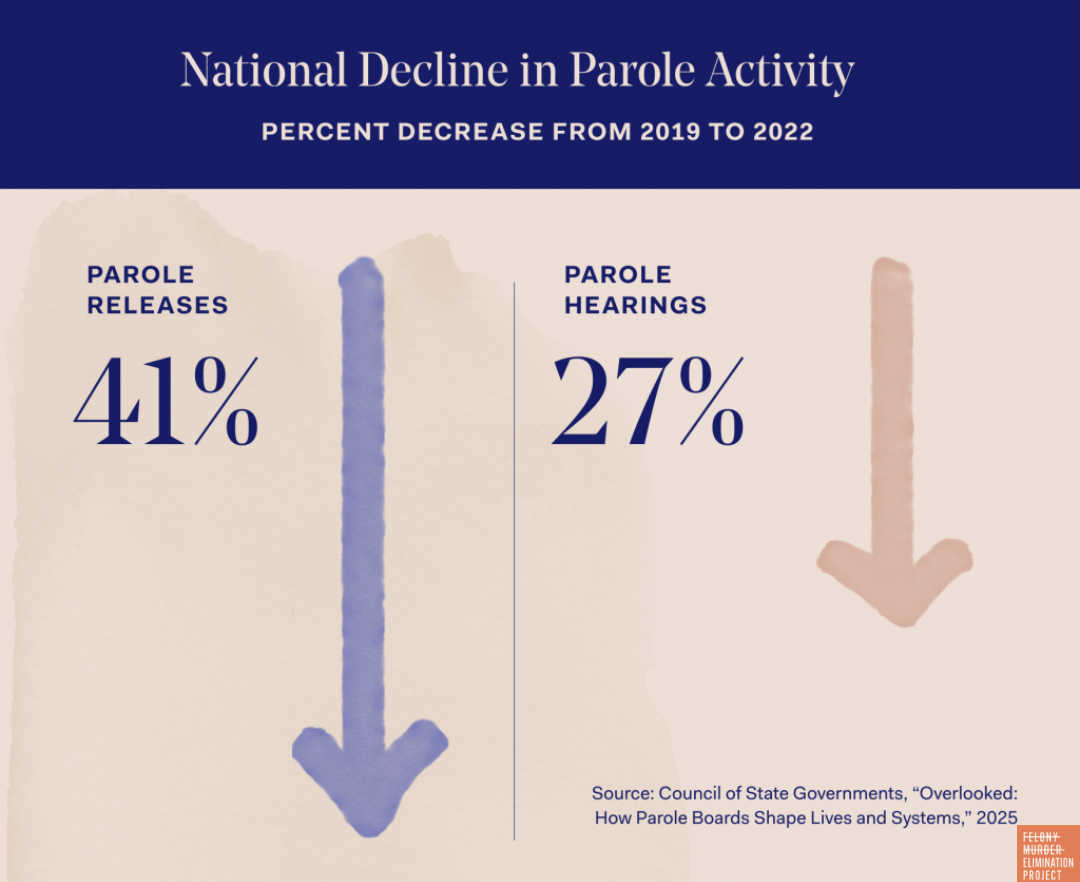
There has been a significant and sustained decline in parole activity in the United States, both in terms of the total population on parole and the rate at which parole is granted. This trend means that many individuals remain incarcerated long past their initial parole eligibility dates, even for nonviolent offenses, which increases the cost of incarceration and can create significant racial disparities in time served.
An October 2025 report from the Prison Policy Initiative brings to light parole release systems, providing the most accessible and comprehensive source to date for comparing how these essential, and often dysfunctional, release mechanisms are set up in 35 states. The report, Parole in Perspective, reveals that parole releases are on the decline in nearly every state that uses discretionary parole, highlighting elements of the process that contribute to this urgent problem.
Parole in Perspective coincides with the Prison Policy Initiative and MacArthur Justice Center’s release of their Principles for Parole Reform, a guiding “North Star” document designed to help activists and policymakers identify priorities for reform in their states.
Both the new report and the Principles for Parole Reform identify crucial flaws in parole systems today, including:
- Relying too heavily on factors outside of applicants’ control, such as “the severity of the offense” or a perception that release would “diminish the seriousness of the crime”;
- Making irrational parole decisions in favor of keeping applicants locked up, often flying in the face of what risk assessment tools recommend;
- Stacking boards with law enforcement professionals, while ignoring the perspective of people with experiences of incarceration;
- Increasingly holding virtual rather than face-to-face hearings, or worse, not affording parole applicants a hearing at all.
Despite their differences, all discretionary parole systems have serious design flaws that lead to an unfair preparation and hearing process for incarcerated people,” said report author Leah Wang.
Parole is a period of supervised, early release from prison. It is an alternative to incarceration that, when done right, can reduce prison costs and reduce crime. Parole can be a tool for transformation. The prospect of parole can provide an incentive for people to participate in educational courses and job training while incarcerated, which can help them succeed when they return home.
“We should be looking at who people are today, not the worst thing they ever did in their life,” Carol Shapiro, who served as a commissioner on the New York State Board of Parole from 2017 to 2019, told New York Focus. “The idea has always been that you do the best you can while you’re incarcerated to improve yourself, to take responsibility, and to become a valued member of our communities.”
FWD.us, a non-profit social welfare organization, recently completed case studies of incarcerated people who were denied parole, and examined parole policies and practices in Missouri, Mississippi, and New York to highlight the systemic barriers to a fair parole process that are contributing to the nationwide decline in parole use.
You can read this report, “They Just Denied Me”: Parole Stories and Case Studies” at the Fwd.us website. FWD.us is a policy organization working to advance better and more politically resilient solutions on criminal justice and immigration.