
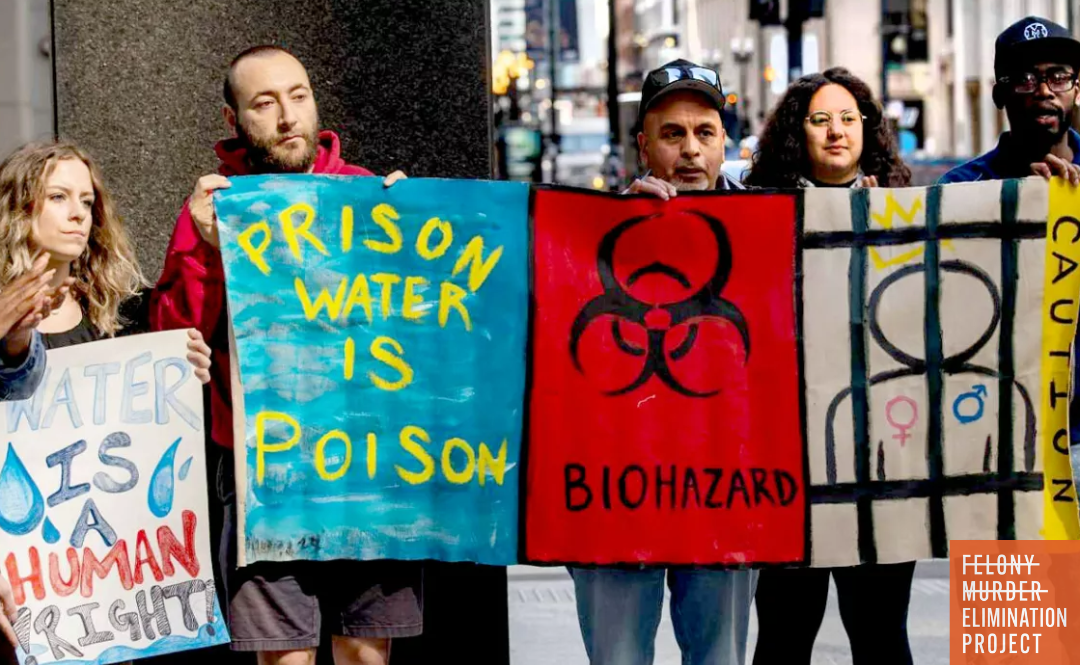
As calls increase for better water quality monitoring and mitigation in rural and economically disadvantaged communities, emerging research adds prisons, jails and detention centers to the areas of concern in ensuring safe drinking water for incarcerated people.
A report published in the American Journal of Public Health finds that 47% of America’s carceral facilities are in a watershed likely contaminated with “forever chemicals” known as PFAS. Because of limited water testing, only 5% of the facilities are in a watershed already known to carry dangerously high levels of these non-biodegradable molecules, but the study shows the true number is likely to be much higher.
Incarcerated populations are of particular concern for toxic drinking water because they have reduced access to mitigating a known exposure. Incarcerated people are generally already in worse health and therefore more vulnerable to acute health impacts compared to the free population. They are also disproportionately people of color and LGBT+, so exposures may heighten preexisting health inequities.
“If you think of the incarcerated population as a city spread out over this vast archipelago of carceral facilities, it would be the fifth largest city in the country, with potentially very high levels of toxicants in its water and no ability to mitigate exposure,” said senior author and medical anthropologist Nicholas Shapiro, an assistant professor in the Institute for Society and Genetics at the University of California – Los Angeles.
Exposure to PFAS (Per- and polyfluoroalkyl substances) is associated with reproductive and developmental effects, certain cancers, liver harm and hormone disruption. The paper notes that in 2023, the EPA proposed to set the maximum allowable level for six PFAS at zero parts per trillion, highlighting the toxicity of these and the government’s concern and interest in regulating them.
Shapiro and co-author Lindsay Poirier, an assistant professor of statistical and data sciences at Smith College, assembled a list of the country’s 6,118 carceral facilities from the Department of Homeland Security and engaged geospatial data analysis to identify those located within watersheds known or likely to be contaminated with PFAS. Co-authors with the PFAS Project Lab at Northeastern University led the identification of PFAS sites, drawing on their database of known PFAS contamination sources, in addition to a previously published model that can identify presumptive contamination.
When all the data was analyzed, 310, or 5% of the carceral facilities were found to be within a watershed and at a lower elevation than at least one known source of PFAS contamination. A minimum of 150,000 people, including at least 2,200 juveniles, reside in these facilities. Nearly half of all facilities (47 percent) have at least one presumptive source of PFAS contamination within the same watershed boundary and at a higher elevation than the facility, including over half (56 percent) of the juvenile facilities.
“The most rigorous and consistent water testing is done in well-resourced or particularly engaged communities, and these are also the communities with the most ability to mitigate their exposure to contaminants when they’re found,” Shapiro said. “Incarcerated populations have a lot in common with marginalized populations elsewhere in the country that lack the resources and political clout to get their water cleaned up. That needs to change.”
You can read an investigative report into the water quality in Texas prisons, “Safe Drinking Water Is a Basic Human Right That Texas Prisons Fail to Respect” at The Appeal website. The Appeal is a nonprofit news organization that envisions a world in which systems of support and care, not punishment, create public safety.